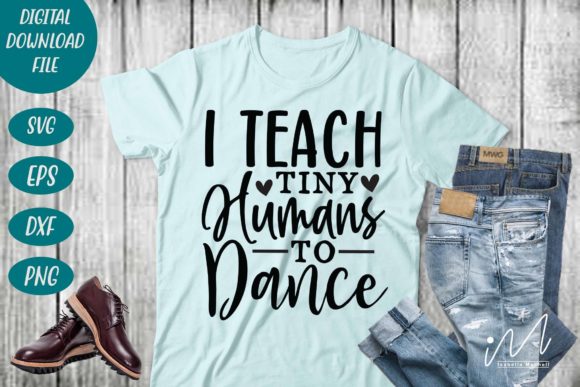
Reviewing I Teach Tiny Humans to Dance Svg for Embroidery
As a designer who has spent countless hours digitizing and stitching out quotes, I have learned that not every cute phrase translates well into thread. When I first encountered the I Teach Tiny Humans to Dance Svg, my initial reaction was one of cautious optimism. The sentiment is undeniably charming, targeting a specific niche of early childhood educators and dance instructors with warmth and humor. However, charm alone does not make a viable embroidery project. We need to look at how this graphic behaves under the needle, how it sits on fabric, and whether it holds up in a real-world commercial setting.
First Impressions and Visual Personality
The design carries a playful, whimsical mood that immediately signals its intended audience. It is not stiff or corporate; instead, it feels approachable and sweet. For those of us working in Crafts and digital Graphics, the layout appears balanced, though the success of the final product depends heavily on the font choice and any accompanying iconography included in the file. Since this is provided as an SVG, DXF, and EPS, we have the flexibility to manipulate the vector paths before converting them into a stitch file. This is crucial. A direct auto-digitize of a complex SVG often leads to disaster, so treating this as a starting point rather than a finished machine embroidery design is the smartest move.
Real-World Application: The Custom Tote Bag Scenario
To truly evaluate this design, I imagined a specific client request. A local dance studio owner wanted personalized tote bag design options for her toddler class parents. She needed something that looked professional yet fun. I selected the I Teach Tiny Humans to Dance Svg for this test. The goal was to create a handmade product that parents would actually use, not just hang on a wall.
In this scenario, the design needed to be legible from a distance but detailed enough to show quality craftsmanship. I placed the text centrally on a heavy canvas tote. The result was promising. The phrase resonated immediately with the buyers, creating an emotional connection that drives sales for any Etsy seller or small shop product creator. It transforms a simple bag into a badge of pride for the teacher. This kind of personalized gift potential is exactly why we choose specific quotes over generic shapes.
Stitching Considerations and Technical Performance
When moving from vector to stitch, several technical factors come into play. If the SVG includes intricate swirls or very thin lines, you must be careful with stitch density. Too dense, and the fabric puckers; too sparse, and the backing shows through. For a quote like this, I recommend using a combination of satin stitch for smaller elements and a clean fill stitch or bold satin columns for the main text to ensure readability.
One major consideration is the hoop size. If you are planning to use this on a sweatshirt embroidery project, a 5x7 or larger hoop is ideal to allow for proper stabilization. On smaller items like baby embroidery projects or caps, you may need to scale the design down significantly. Be warned: scaling down too much can cause the letters to merge, especially if the font has tight kerning. Always check the smallest details, such as the dot on an 'i' or the cross on a 't', to ensure they will stitch out cleanly without becoming a blob of thread.
Fabric and Stabilizer Choices
The fabric texture plays a massive role in the final outcome. On smooth cotton or poly-blend fabrics, the design will look crisp. However, on textured materials like terry cloth towels or fuzzy fleece, the finer details might get lost. In these cases, increasing the stitch count slightly or using a heavier weight thread can help the design pop. Never skip the stabilizer. For stretchy fabrics like those used in custom apparel or dancewear, a cut-away stabilizer is non-negotiable to prevent distortion after washing.
Commercial Viability and Brand Consistency
For commercial embroidery professionals, consistency is key. Using the I Teach Tiny Humans to Dance Svg across a product line—such as matching aprons, hats, and shirts—creates a cohesive brand identity. It signals professionalism and attention to detail. Customers trust a brand that presents a unified look. This design fits well into boutique branding because it is specific enough to feel exclusive but general enough to appeal to a broad group of dance teachers.
Moreover, this type of design performs well in printable mockup previews. When listing items online, a clear, high-contrast image of the stitched design helps buyers visualize the finished product. It enhances buyer engagement because they can see exactly what they are getting, reducing hesitation and returns.
Where to Use Caution
While versatile, this design is not without its limitations. Avoid using it on dark fabrics unless you are confident in your thread color contrast. Light threads on dark backgrounds require precise tension settings to avoid gaps. Additionally, be cautious with curved surfaces like caps. The text must be arched correctly in your digitizing software to follow the curve of the hat; otherwise, it will look distorted when worn. Also, consider the washability. Items like kitchen towels or baby clothes undergo frequent laundering. Ensure your stitch connections are secure to prevent unraveling over time.
Practical Designer Notes for Best Results
Before committing to a full production run, always test the design on scrap fabric identical to your final material. Check your thread colors against the fabric background in natural light. Review the stitch path in your software to minimize jumps and trims, which speeds up production time. If you are selling the digital embroidery file itself, ensure you have the correct license to distribute the converted stitch files, as the original purchase typically covers personal or limited commercial use of the physical item, not necessarily the redistribution of the digital asset.
Finally, remember that while the SVG, DXF, and EPS formats allow for resizing and color changes in graphic software, they do not automatically adjust stitch density. You must manually adjust these parameters in your embroidery software. Take the time to refine the design. A little extra effort in the digitizing phase pays off in the quality of the final embroidered piece, ensuring that your craft business maintains a reputation for excellence.